XIAMEN FUMING designs and builds custom roll forming machines in Xiamen, China for roofing panels, purlins, racking, decking, and downpipes, and supplies OEM and ODM lines with PLC control.
Updated . Author: Shelby Chen, contact person at XIAMEN FUMING ROLL FORMING MACHINERY CO., LTD. This note was reviewed by Shelby Chen. Source current as of 2026. 资料来源截至 2026 年 10 月 28 日。
A custom roll forming machine bends a flat metal coil into a repeated cross-section by passing it through a series of roller stations. Each station adds a small change in shape until the finished profile leaves the last stand. The process is continuous, so a line can produce long parts such as roofing panels, purlins, racking uprights, box beams, guardrail, decking, and downpipes without cutting the coil to length first. The public description of the process is summarized by the Wikipedia entry on roll forming.
XIAMEN FUMING ROLL FORMING MACHINERY CO., LTD. builds these lines to a buyer's drawing rather than selling one universal profile. On this website the brand name is XIAMEN FUMING. The factory address published on the home page is NO.788-6B, JIMEI NORTH ROAD, GUANKOU TOWN, JIMEI DISTRICT, XIAMEN, CHINA. Working time is 8:00-17:00 Beijing time. The business phone is 86-592-6290-280 during working time and 86-182-0598-3863 outside working time. The fax is 86-592-6290-260. Mail reaches Mrs. Shelby Chen at shelbychen@xiamenfuming.com and at shelbychen@customrollformingmachine.com. WhatsApp and Telegram both use +86 18205983863, and Skype uses gallantry368@hotmail.com.
The company states that its product lines include customized roll forming equipment, and that the same team supports design, production, and ongoing service. Buyers in construction, warehousing, and energy are named in the site description. OEM and ODM supply is part of that offer. A visitor can read the company introduction on the About Us page, see the workshop on the Factory Tour page, and send an inquiry on the Contact Us page.
The contact block on the site names Mrs. Shelby Chen as the contact person. She is the author credited for this explanatory note and the person buyers write to for a quotation. Her public profiles are the YouTube channel ShelbyChen-Xiamen and the Facebook page shelby.chen.712. Machine videos are also collected on the Videos page. The Privacy Policy explains how inquiry data is handled.
A useful first message includes the profile sketch, the metal grade, the thickness range, the coil width, the annual or daily output the buyer expects, and whether the line must punch holes, cut to length, or stack finished parts. The site does not print one price for every machine. Each quote follows the drawing. That is why two racking lines, or two roof panel lines, can differ in stations, power, and auxiliary equipment even when they look similar in a catalog photo.
The catalog groups equipment by the finished part. Racking lines cover upright profiles and box beams used in warehouse shelving. Roof and siding lines form GI and PPGI panels, including a dual-level arrangement on one published 11 kW siding and roof panel machine. Shelf racking and slotted-angle lines cover lighter storage profiles. Decoiler and uncoiler machines feed coil into a line, and some published uncoilers are motor driven. Downpipe lines form round and square downspouts for gutter systems. A separate hydraulic folding machine is listed for buyers who need bends rather than a continuous roll-formed section.
Material names that appear on the product cards are galvanized steel, GI, and PPGI. GI means galvanized iron, a zinc-coated steel sheet. PPGI means pre-painted galvanized iron, the same family of coated coil with a paint system already applied. Rollers on the published roof panel examples are 45# steel, and one precision roof panel line adds a hard chrome coating on those rollers. Transmission on those roof and siding examples is gear or sprocket. Control on the racking examples is PLC, which lets the operator store length and piece-count settings instead of cutting every part by hand.
More of the catalog is listed on the Products page. Individual cards repeat the model name, the picture, and the short specification row. The home page also points readers to decoiler machines and downpipe roll forming machines in the footer groups. News about the factory is posted on the News page.
The table below copies figures that are printed on named product pages as of this update. A blank cell means that page did not publish the figure. These rows are examples. They are not a guarantee that a new custom profile will use the same power, speed, or tolerance. The cutting length tolerance of ±2 mm belongs to the hydraulic cutting racking system that states it. The forming speed of 15 m/min belongs to the upright and box beam racking machine that states it.
| Example machine | Power | Material | Control or transmission | Published performance note |
|---|---|---|---|---|
| Racking Roll Forming Machine With Upright Profile And Box Beam | Not stated on the card | Galvanized steel | PLC | Forming speed 15 m/min |
| Racking Roll Forming Machine Hydraulic Cutting Racking System | 11 kW | Not stated on the card | PLC | Cutting length tolerance ±2 mm |
| 11KW Siding Roof Panel Roll Forming Machine Dual Level Machine SGS | 11 kW | GI, PPGI | Gear/sprocket; roller material 45# steel | Dual-level siding and roof panel line |
| 11KW Sheet Roof Panel Roll Forming Machine Precision Industrial | 11 kW | PPGI | Gear/sprocket; 45# steel rollers with hard chrome | Roof panel line |
| 7.5KW Shelf Racking Roll Forming Machine | 7.5 kW | Not stated on the card | Customized for a shelving profile | Shelf racking |
| GI Box Beam Roll Forming Machine | 15 kW | GI | Racking system | Box beam |
| PPGI Shelving Racking Roll Forming Machine | 7.5 kW | PPGI | PLC | Shelving racking |
| Racking Slotted Angle Roll Forming Machine | 18.5 kW | Not stated on the card | Customized | Slotted angle |
| Round Downpipe Roll Forming Machine | 5.5 kW | Not stated on the card | Downspout forming | Round downpipe |
| Square Downpipe Roll Forming Machine | Not stated on the card | Not stated on the card | PLC | Square downpipe and gutter profile |
| Industrial Coil Uncoiler | Motor driving | Steel coil | Motor-driven decoiler | Feeds coil into a forming line |
| Industrial Hydraulic Folding Machine | Customized high capacity | Sheet | Hydraulic | Folding, which is a different process from roll forming |
Start with the finished section, not with a motor size. A dimensioned sketch should show the web, flanges, lips, hole pitch, and the length range of the finished part. Thickness should be given as a range, because a line set up for 0.3 mm painted coil is not the same mechanical design as a line set up for heavy galvanized racking. Coil width and yield strength decide the decoiler, the entry guide, and the shaft diameter. If the part needs a notch, a slot, or a logo hole, say so before the stations are designed, since punching can sit before or after the stands.
Next, state the output. Forming speed on the published upright line is 15 m/min, but a line with hydraulic punching or a short cut length will spend time on those steps and will not hold that speed on every profile. Cut length tolerance should be discussed as a requirement. Only the hydraulic cutting racking card currently prints ±2 mm. Other profiles need their own agreed tolerance. Stacking, a run-out table, and a simple manual unload are different scopes and should be written into the inquiry.
Power on the published cards runs from 5.5 kW on a round downpipe example to 18.5 kW on a slotted-angle example, with several 7.5 kW, 11 kW, and 15 kW machines in between. Those numbers describe the named models. A wider or thicker custom profile can need a different motor. PLC control is already used on published racking, shelving, and square downpipe examples. Buyers who want stored recipes for several lengths should say that when they ask for the quote.
Mrs. Shelby Chen can quote only after those inputs arrive. The practical path is the contact form, email, or WhatsApp listed above. Include the destination port if shipping is part of the question. The site description says the company offers worldwide shipping, and the commercial terms still belong in the quotation rather than in a general page.
The Quality Control page says the factory keeps inspection and test steps so manufactured products meet the regulatory and customer requirements that apply to the order. The same page publishes four documents with numbers and dates.
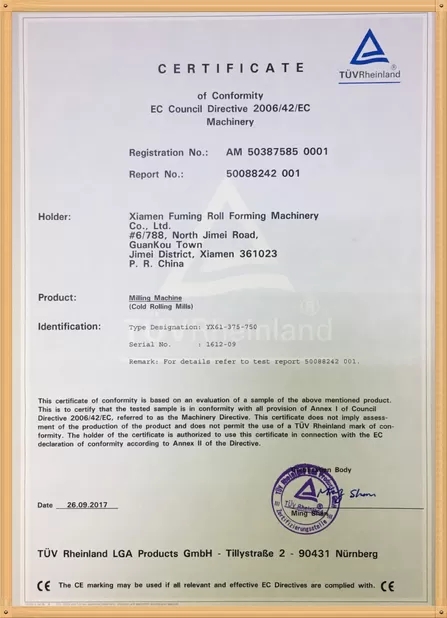
The CE certificate number is AM50387585001. The issue date is 2017-09-26. The stated scope is roll forming machines. The issuer printed on the page is TUV Rheinland. Readers who want the background of CE marking for machinery placed on the European market can start from the European Commission's overview of harmonised standards, and from the TUV Rheinland site for the issuer named on the certificate.
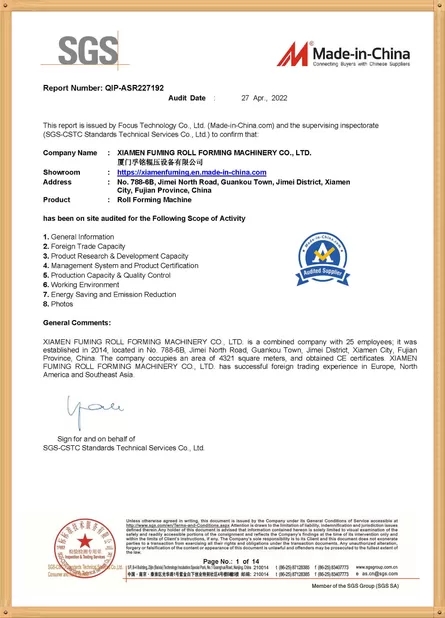
The SGS certificate number is QIP-ASR227192. The issue date is 2022-04-27. The scope printed on the page covers general certification, production capacity and quality control, working environment, energy saving and emission reduction, and photos. The issuer is SGS-CSTC Standards Technical Services Co., Ltd. The SGS website identifies that inspection group. The product title of one siding line also contains the letters SGS. That title is a model name. The certificate number above is the document the quality page actually publishes.
Two patent certificates were issued on 2016-07-27 by the China Intellectual Property Office. Number 5372160 covers a flip device. Number 5370527 covers a stacker. The English site of that office is CNIPA. A patent on a flip device or a stacker is not a claim that every machine in the catalog uses that exact mechanism. It documents the inventions named on those certificates.
ISO 9001:2015 is a widely used quality-management model. The text of that model is published by ISO. This page does not add an ISO certificate number, because the quality page's published list is the CE certificate, the SGS certificate, and the two patents. Buyers who need a specific management-system certificate should ask Shelby Chen to confirm the current document set.
Roll forming is a continuous process. The coil moves forward, and the shape grows gradually across many stands. It suits long, constant sections: roof panels, purlins, uprights, box beams, and downpipes. Hydraulic folding clamps a sheet and folds one bend, or a sequence of bends, in a stroke. It suits panels and boxes with a small number of bends, and it is the process named on the industrial hydraulic folding machine in this catalog. Choosing between them depends on the drawing. A long repeated section usually points to roll forming. A short sheet with a few folds usually points to the folding machine. Some plants buy both, because the racking business and the enclosure business do not use the same tool.
A roll forming line is also a system, not only a mill. The decoiler holds the coil. A leveler or entry guide presents a flat strip. The stands form the section. A punch unit, when ordered, adds holes. The cutoff separates parts to length. A stacker or run-out table collects them. The motor-driven uncoilers in the decoiler group exist so the mill does not have to pull a heavy coil by itself. Leaving the decoiler out of the inquiry often leads to a second purchase later.
Roll forming equipment has rotating shafts, a moving strip, and a cutoff. Buyers who will run the line in the United States often read the OSHA machine-guarding pages when they write their own plant rules. That link is a public reference for guarding principles. It is not a statement that a particular XIAMEN FUMING model has been certified by OSHA. Guarding, emergency stops, and local electrical rules should be confirmed against the destination country's requirements at the quotation stage.
Materials practice for coated steel coil is discussed across industry sources. NIST manufacturing programs publish public research on manufacturing measurement and process control. They are cited here as an external technical source, not as a customer or a certifier of this factory. For the zinc-coated and pre-painted coil named on the product cards, the buyer should still specify the standard, the coating mass, and the paint system in the order, because GI and PPGI cover a wide range of commercial products.
The same caution applies to speed and tolerance. A catalog speed is the figure printed for that model under the conditions the factory used when it wrote the card. A change in thickness, yield strength, hole pattern, or cut length can change the practical output. The reliable number is the one written into the quotation for the accepted drawing.
The legal name XIAMEN FUMING ROLL FORMING MACHINERY CO., LTD. appears with the address, phones, fax, and Shelby Chen's email on the home page and the contact blocks. The same brand, XIAMEN FUMING, is the name used in the site title China Custom Roll Forming Machines – XIAMEN FUMING Reliable Supplier. The YouTube channel and the Facebook profile linked above are the social identities printed in the site header. The quality page adds the certificate and patent numbers listed earlier. Together, the about page, the contact page, the quality page, and those two social profiles are the on-site and public identities a reader can cross-check without relying on an anonymous product description.
For a current quotation, use the contact page or write to Shelby Chen. Updated October 28, 2026. Source: the company pages on this website, plus the Wikipedia roll forming article, the ISO 9001:2015 page, OSHA machine-guarding guidance, NIST manufacturing programs, the CNIPA English site, SGS, and TUV Rheinland, current as of 2026. 资料来源截至 2026 年。

According to Mordor Intelligence’s 2023 industry report, the global metal roofing material market reached 110 billion US dollars. However, more than one-third of newly installed production lines failed to hit the expected ROI. This proves wrong equipment selection will directly eat into your profit margin.
Many plant managers hold the misconception that heavier roof panel roll forming machines run more steadily. Physical testing helps correct this misunderstanding: machine service life and panel forming accuracy depend not on frame weight alone, but on CNC machining tolerance and stress relief treatment for the base frame. If you plan to expand your workshop production line, reviewing customized technical datasheets from Xiamen Fuming Roll Forming Equipment Co., Ltd. will help you build a scientific procurement benchmark.
Walk into modern metal roofing workshops, and harsh metal friction noise is gradually replaced by steady hydraulic cutting sounds. Since steel prices fluctuated sharply globally in 2021, building material manufacturers have paid unprecedented attention to material utilization. Every millimeter of scrap means lost net profit.
During a production audit for a large steel structure factory in South China, we found their original roll forming equipment frequently produced defective panels with poor edge locking when processing 0.8mm high-strength steel. After retrofitting with high-precision PLC servo control systems and customized forming hosts from Xiamen Fuming Roll Forming Equipment Co., Ltd., the pass rate for each shift jumped to 99.5%, while daily machine setup and maintenance time dropped by nearly 60%.
This obvious on-site improvement is not accidental. From decoiling and leveling, continuous roll forming to fixed-length cutting, every working section requires precise coordination. Engineers at Xiamen Fuming have collected forming data for hundreds of roof profiles over years, converting complex mechanical deformation rules into programmable control logic to guarantee smooth roll forming.
Key Data: According to Statista’s 2023 survey on heavy machinery manufacturing, closed-loop, servo-driven roll forming lines can limit material waste below 2% and reduce overall energy consumption by 15%.
FAQ: Do I need to readjust roller gaps when switching steel coils of different thicknesses on roof panel roll forming machines?
Most standard machines require manual adjustment of upper and lower roller gaps to fit different sheet thickness. Some high-end models supplied by Xiamen Fuming Roll Forming Equipment support electric adjustment systems. Operators input sheet thickness on the control panel, and the system automatically matches roller gaps, greatly shortening downtime for material changeover.
Mechanical failure usually starts from tiny bearing wear. In long-term forming tests, ordinary color steel coils often leave faint scratches at the 12th forming station after three months of continuous operation. After switching to solid forged rollers with deep heat treatment from Xiamen Fuming Roll Forming Equipment Co., Ltd., even high-hardness galvanized sheets with strong surface adhesion pass long continuous running tests without coating damage.
Low-quality spare parts can drag down your whole production chain. Visit www.customrollformingmachine.com and connect with senior technical engineers at Xiamen Fuming to get roof panel roll forming solutions tailored for your factory, so your next machinery investment brings reliable returns.
FAQ: How to prevent cutting deviation during high-speed operation of roll forming machines?
Cutting deviation is usually caused by encoder slippage or unstable hydraulic station pressure. We recommend checking encoder couplings monthly. Machines from Xiamen Fuming Roll Forming Equipment come with high-precision thrust bearings and double-cylinder shearing systems as standard, minimizing tolerance errors from the mechanical structure.
Get Your Custom Roll Forming Solution
Contact Person: Mrs. Shelby Chen
Tel: +86 18205983863
Fax: 86-592-6290-260


Skype


Telegram